
13. Data Migration and Setup
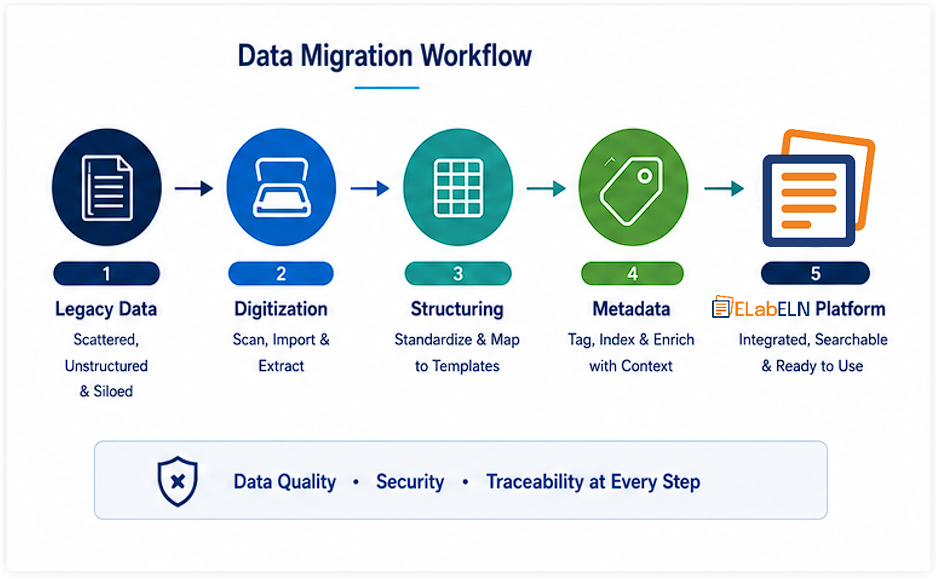
Data migration is one of the most technically and operationally challenging aspects of implementing an Electronic Lab Notebook. While selecting and configuring the system are critical steps, the success of the implementation ultimately depends on how effectively existing data is transitioned into the new environment.
In academic research, data exists in many forms—paper notebooks, spreadsheets, instrument files, shared drives, and cloud storage platforms. This diversity makes migration complex. Institutions must decide not only how to move data, but also what data should be migrated, how it should be structured, and how it will be used going forward.
A thoughtful approach to data migration ensures that valuable historical data is preserved while laying the foundation for consistent, high-quality data management in the future.
Digitizing Legacy Notebooks
Many academic labs still rely heavily on paper notebooks. Digitizing these records is often the first step in the migration process. However, this is not simply a matter of scanning pages.
While scanning can preserve visual records, it does not make the data structured or searchable. Institutions must decide whether to:
- Archive scanned notebooks as reference materials
- Extract and structure key data for active use
- Recreate critical experiments in the ELN format
Each approach has trade-offs. Fully digitizing and structuring all historical data can be time-consuming and costly, while simple archiving may limit usability.
A pragmatic approach is often most effective. Institutions can prioritize high-value data—such as ongoing projects or frequently referenced experiments—while archiving less critical records for future reference.
Structuring Data in the ELN
Once data is digitized, it must be structured within the ELN. This involves organizing information into templates, defining fields, and ensuring consistency across records.
Structured data is essential for enabling search, analysis, and reuse. Without it, the ELN becomes little more than a digital filing system. Proper structuring ensures that data can be easily located, compared, and integrated with other systems.
Developing templates is a key part of this process. Templates standardize how experiments are documented, ensuring that essential information is captured consistently. At the same time, they must remain flexible enough to accommodate different types of research.
The goal is to create a system that supports both standardization and adaptability, enabling researchers to work efficiently while maintaining data quality.