
7. Compliance and Regulatory Considerations
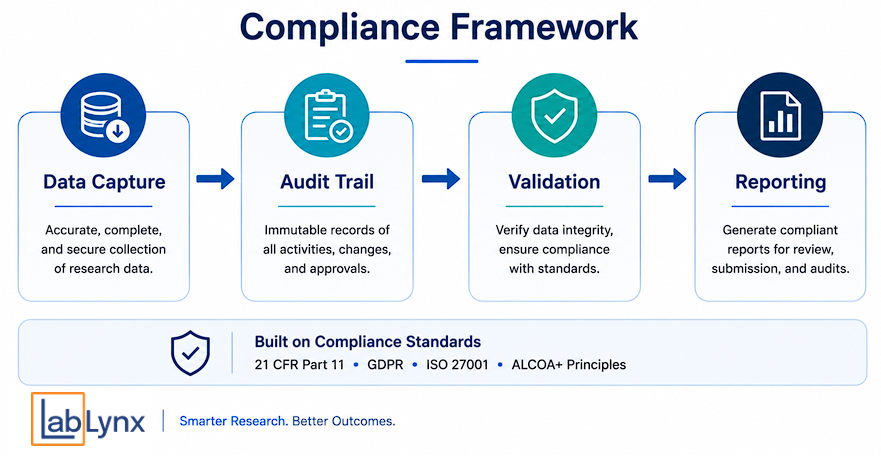
Compliance has become a central concern in academic research, driven by increasing regulatory requirements, funding agency expectations, and the broader push toward transparency and reproducibility. While academic institutions historically operated with a high degree of autonomy, they are now subject to more formalized standards governing how data is collected, stored, and shared.
This shift reflects the growing recognition that research data is not only a scientific asset but also a regulatory and institutional responsibility. Ensuring that data is accurate, secure, and traceable is essential for maintaining credibility and meeting external obligations.
Electronic Lab Notebooks play a critical role in addressing these requirements. By providing structured, auditable systems for managing data, ELNs enable institutions to meet compliance standards while supporting efficient research workflows.
Research Integrity Requirements
Research integrity is the foundation of scientific credibility. It encompasses principles such as honesty, accuracy, and transparency in the conduct and reporting of research. Maintaining these standards requires reliable systems for documenting and managing data.
Traditional methods of documentation often fall short in this regard. Inconsistent record-keeping, missing information, and lack of traceability can undermine the integrity of research. Without clear documentation, it becomes difficult to verify results or reproduce experiments.
ELNs address these challenges by enforcing structured data capture and maintaining comprehensive records of research activities. Features such as time-stamping and version control ensure that all changes are recorded, providing a transparent history of the work. This not only supports integrity but also builds confidence in the results.