
7. Compliance and Regulatory Considerations
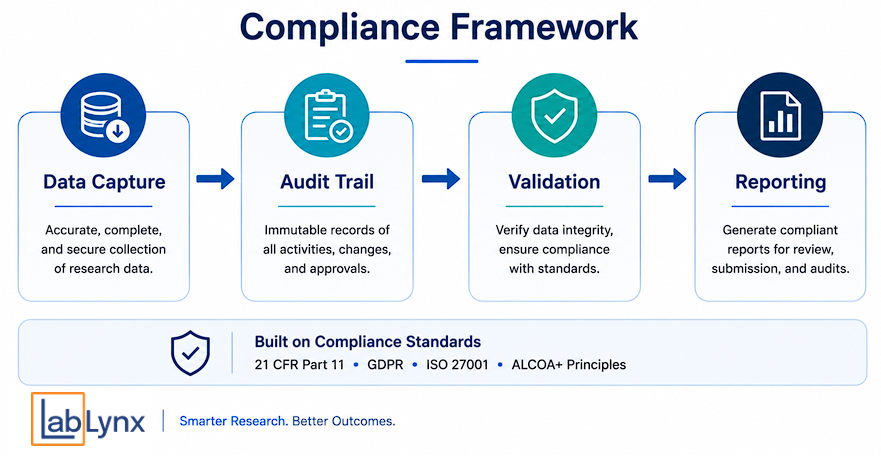
Compliance has become a central concern in academic research, driven by increasing regulatory requirements, funding agency expectations, and the broader push toward transparency and reproducibility. While academic institutions historically operated with a high degree of autonomy, they are now subject to more formalized standards governing how data is collected, stored, and shared.
This shift reflects the growing recognition that research data is not only a scientific asset but also a regulatory and institutional responsibility. Ensuring that data is accurate, secure, and traceable is essential for maintaining credibility and meeting external obligations.
Electronic Lab Notebooks play a critical role in addressing these requirements. By providing structured, auditable systems for managing data, ELNs enable institutions to meet compliance standards while supporting efficient research workflows.
Research Integrity Requirements
Research integrity is the foundation of scientific credibility. It encompasses principles such as honesty, accuracy, and transparency in the conduct and reporting of research. Maintaining these standards requires reliable systems for documenting and managing data.
Traditional methods of documentation often fall short in this regard. Inconsistent record-keeping, missing information, and lack of traceability can undermine the integrity of research. Without clear documentation, it becomes difficult to verify results or reproduce experiments.
ELNs address these challenges by enforcing structured data capture and maintaining comprehensive records of research activities. Features such as time-stamping and version control ensure that all changes are recorded, providing a transparent history of the work. This not only supports integrity but also builds confidence in the results.
Data Security and Privacy (FERPA, GDPR, etc.)
Academic institutions must comply with a range of data protection regulations, including FERPA in the United States and GDPR in the European Union. These regulations govern how personal and sensitive data is handled, requiring institutions to implement appropriate safeguards.
In research environments, data may include sensitive information such as patient records, proprietary findings, or unpublished results. Protecting this data is both a legal and ethical obligation. Failure to do so can result in significant penalties and damage to institutional reputation.
ELNs provide robust security features to address these requirements. Encryption ensures that data is protected during storage and transmission, while authentication mechanisms control access to the system. Role-based access controls allow institutions to define who can view or modify specific data, ensuring that sensitive information is only accessible to authorized users.
Funding Agency Requirements
Funding agencies increasingly require detailed data management plans and reporting as part of the research process. These requirements are designed to ensure that data is properly managed, accessible, and reusable.
Researchers must demonstrate that they have systems in place to capture and store data, maintain documentation, and share results as appropriate. Meeting these requirements can be challenging without a structured system.
ELNs simplify this process by providing a centralized platform for managing data. Structured templates and automated workflows ensure that required information is captured consistently. Reporting tools can generate the documentation needed to satisfy funding agency requirements, reducing the administrative burden on researchers.
Audit Trails and Version Control
Audit trails and version control are essential components of compliance. They provide a record of all changes made to data, including who made the change and when it occurred. This level of traceability is critical for both internal quality control and external audits.
In traditional systems, maintaining such records can be difficult and error-prone. Manual processes are often incomplete or inconsistent, making it challenging to reconstruct the history of a dataset.
ELNs automate this process, ensuring that all changes are recorded systematically. Version control allows researchers to track the evolution of their work, while audit trails provide a verifiable record for compliance purposes. These features are particularly important in regulated environments, where documentation must withstand scrutiny.
Data Retention and Archiving Policies
In addition to capturing and managing data, institutions must also consider how long data should be retained and how it should be archived. Data retention policies vary depending on the type of research, regulatory requirements, and institutional guidelines.
Proper archiving ensures that data remains accessible and usable over time. This is particularly important for long-term research projects or when data may be needed for future validation or replication.
ELNs support data retention and archiving by providing structured storage and retrieval capabilities. Data can be organized, indexed, and preserved in a way that ensures long-term accessibility. This reduces the risk of data loss and supports ongoing research efforts.
Common Pitfall
 A common pitfall in addressing compliance is treating it as an afterthought. Institutions may focus on implementing research tools without fully considering regulatory requirements, only to face challenges later.
This reactive approach can result in costly adjustments, delays, and potential non-compliance. Instead, compliance should be integrated into the design and implementation of research systems from the outset.
By adopting ELNs that are designed with compliance in mind, institutions can proactively address regulatory requirements while supporting efficient workflows.