
8. Cost and ROI Analysis
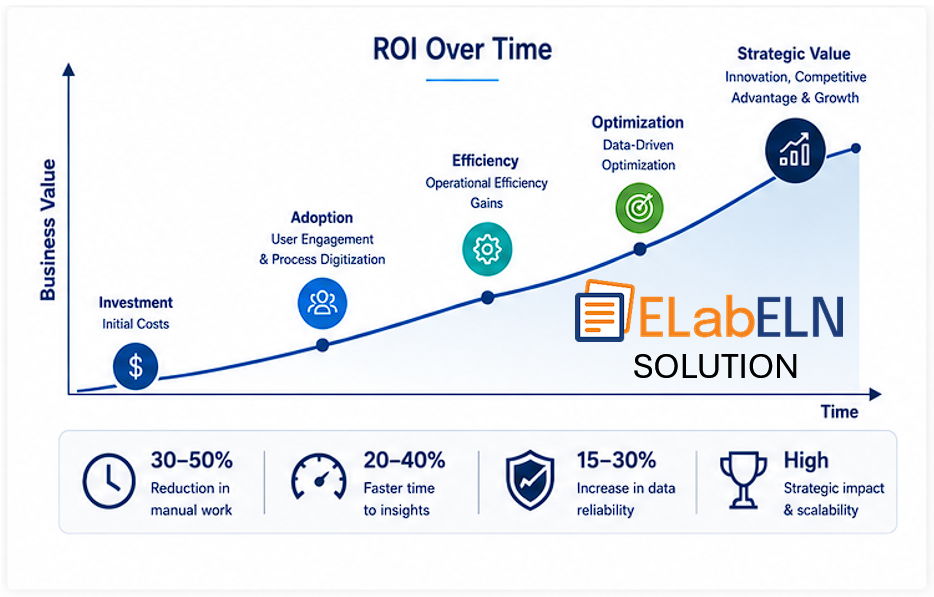
The decision to implement an Electronic Lab Notebook is often evaluated through the lens of cost. Licensing fees, implementation expenses, and training investments can appear significant, particularly in academic environments where budgets are constrained. However, focusing solely on upfront costs can obscure the broader financial and strategic impact of ELN adoption.
A more comprehensive approach considers the total cost of ownership alongside the long-term return on investment (ROI). ELNs are not simply expenses—they are infrastructure investments that enable efficiency, reduce risk, and enhance research outcomes. When evaluated over time, their value becomes increasingly clear.
Understanding both the costs and the benefits associated with ELNs is essential for making informed decisions. Institutions that take a strategic approach to ROI analysis are better positioned to justify investment and realize the full potential of these systems.
Licensing Models
ELNs are typically offered through a variety of licensing models, each with its own implications for cost, flexibility, and scalability. The most common models include subscription-based licensing and perpetual licensing.
Subscription models provide access to the system for a recurring fee, often on a per-user or per-institution basis. This approach offers flexibility, allowing institutions to scale usage up or down as needed. It also ensures access to updates and support, which are typically included in the subscription.
Perpetual licensing involves a one-time purchase of the software, often accompanied by ongoing maintenance fees. While this model can reduce long-term costs, it requires a larger initial investment and may place greater responsibility on the institution for updates and support.
Selecting the appropriate licensing model depends on factors such as budget constraints, expected growth, and the institution’s ability to manage and maintain the system. A careful evaluation of these factors is essential for aligning the licensing approach with institutional goals.
Implementation Costs
Beyond licensing, implementation costs represent a significant component of ELN adoption. These costs include system configuration, data migration, integration with existing systems, and initial training.
The complexity of implementation can vary widely depending on the scope of the deployment. A single-lab implementation may require minimal configuration, while an institution-wide rollout may involve extensive customization and integration efforts.
Proper planning is critical to managing implementation costs effectively. By clearly defining requirements, engaging stakeholders, and adopting a phased approach, institutions can reduce the risk of unexpected expenses and ensure a smoother deployment.
Training and Support
Training and support are essential for ensuring that users can effectively utilize the ELN. Without adequate training, even the most advanced system may fail to deliver value.
Training programs should be tailored to different user groups, taking into account varying levels of experience and technical proficiency. Initial training should be complemented by ongoing support, including documentation, help desks, and user communities.
Support costs may be included in licensing fees or provided as separate services. Regardless of the model, investing in user enablement is critical for maximizing adoption and ensuring that the system is used effectively.
Operational Efficiency Gains
One of the most significant sources of ROI from ELNs is the improvement in operational efficiency. By automating routine tasks and streamlining workflows, ELNs reduce the time required for data entry, retrieval, and reporting.
For example, automated data capture from instruments eliminates the need for manual transcription, reducing both time and the risk of errors. Advanced search capabilities allow researchers to quickly locate information, minimizing time spent on administrative tasks.
These efficiency gains enable researchers to focus on higher-value activities, such as analysis and discovery. Over time, this can lead to faster project completion and increased research output.
Risk Reduction and Compliance Value
ELNs also provide significant value by reducing risk. Data loss, non-compliance, and errors in documentation can have serious consequences, including loss of funding, reputational damage, and legal liabilities.
By providing structured, secure, and auditable systems, ELNs mitigate these risks. Features such as version control, audit trails, and access controls ensure that data is properly managed and protected.
The value of risk reduction is often difficult to quantify, but it is a critical component of ROI. Avoiding even a single compliance issue or data loss event can justify the investment in an ELN.
Long-Term Strategic Value
Beyond immediate efficiency gains and risk reduction, ELNs provide long-term strategic value. They enable institutions to build a comprehensive repository of research data, supporting knowledge sharing and collaboration.
This repository becomes a valuable asset over time, enabling researchers to build on previous work and identify new opportunities. It also supports institutional goals such as improving research quality, increasing funding success, and enhancing reputation.
As research environments continue to evolve, the ability to leverage data effectively will become increasingly important. ELNs provide the foundation for this capability, positioning institutions for future success.
LabLynx Insight
 The LabLynx ELabELN Suite is designed to deliver strong ROI by combining efficiency, integration, and scalability. Its unified platform reduces the need for multiple systems, lowering both direct and indirect costs.
By enabling institutions to streamline workflows, improve data management, and reduce risk, LabLynx supports both immediate and long-term value creation.
Best Practice
 When evaluating ELN investments, consider the total cost of ownership rather than just upfront expenses. Include factors such as efficiency gains, risk reduction, and long-term strategic benefits in the analysis.