
Introduction
Diagram: Fragmented vs. Centralized Data ModelMultiple silos → Unified ELN platform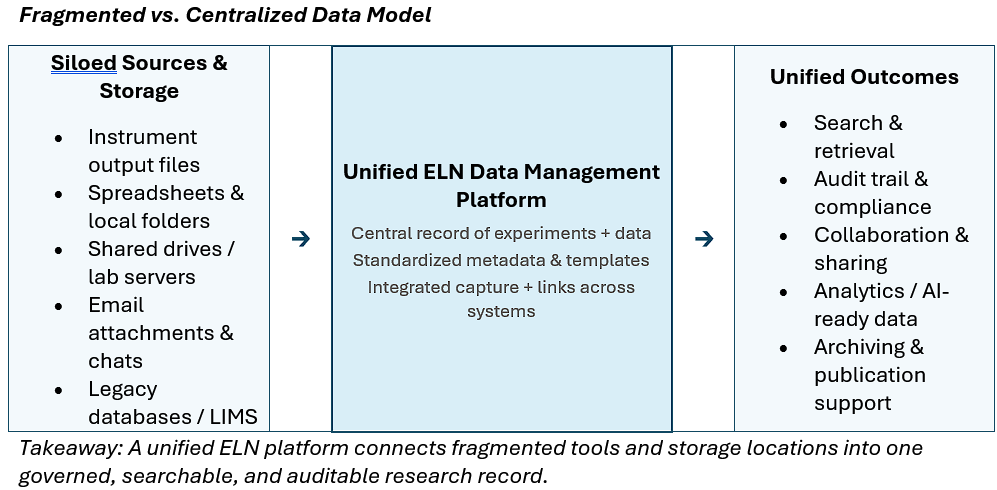
Academic research operates in a uniquely complex environment. Unlike industry laboratories, which often benefit from standardized processes and centralized governance, academic labs are decentralized by design. Individual research groups operate with significant autonomy, choosing their own tools, methods, and data management practices.
While this autonomy fosters innovation, it also introduces significant challenges. Data is generated in diverse formats, stored across multiple systems, and managed with varying levels of rigor. As research becomes more collaborative and data-intensive, these inconsistencies create friction that can hinder progress.
The increasing emphasis on reproducibility, transparency, and compliance further amplifies these challenges. Funding agencies, journals, and regulatory bodies now expect structured, accessible, and auditable data. Meeting these expectations requires systems that can bring order to the inherent complexity of academic research.