
3. Challenges in Academic Research Data Management
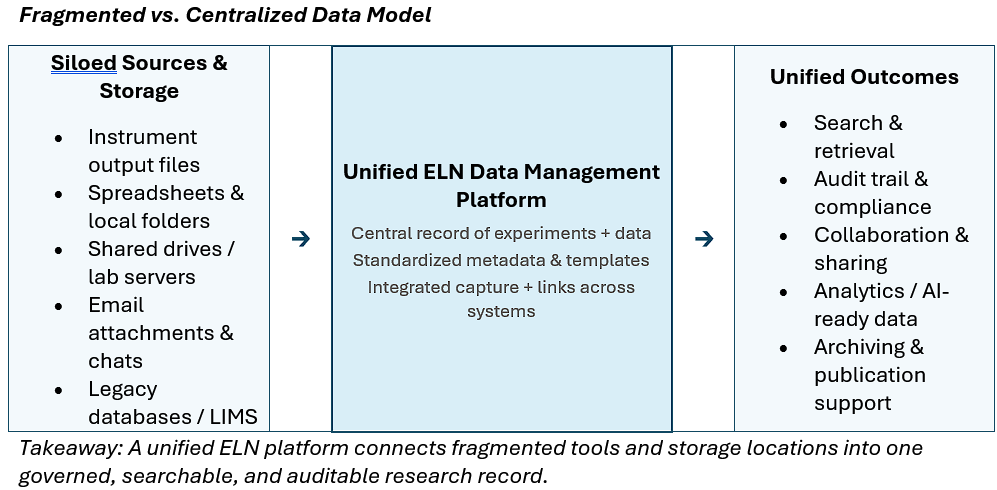
Academic research operates in a uniquely complex environment. Unlike industry laboratories, which often benefit from standardized processes and centralized governance, academic labs are decentralized by design. Individual research groups operate with significant autonomy, choosing their own tools, methods, and data management practices.
While this autonomy fosters innovation, it also introduces significant challenges. Data is generated in diverse formats, stored across multiple systems, and managed with varying levels of rigor. As research becomes more collaborative and data-intensive, these inconsistencies create friction that can hinder progress.
The increasing emphasis on reproducibility, transparency, and compliance further amplifies these challenges. Funding agencies, journals, and regulatory bodies now expect structured, accessible, and auditable data. Meeting these expectations requires systems that can bring order to the inherent complexity of academic research.
Data Fragmentation and Loss
One of the most persistent challenges in academic research is data fragmentation. Researchers often store data in a variety of locations, including personal laptops, external drives, departmental servers, and cloud-based platforms. Each of these storage methods has its own advantages, but together they create a fragmented data landscape.
This fragmentation makes it difficult to locate and access data when it is needed. Researchers may spend significant time searching for files, reconstructing datasets, or recreating experiments because original data cannot be found. This inefficiency slows progress and reduces productivity.
Data fragmentation also increases the risk of data loss. Files stored on personal devices may be lost due to hardware failure, accidental deletion, or personnel turnover. When researchers leave an institution, their data often leaves with them, creating gaps in institutional knowledge.
A centralized system, such as an ELN, addresses these issues by providing a single, structured repository for research data. By consolidating data into a unified platform, institutions can improve accessibility, reduce duplication, and preserve valuable information over time.