
4. Benefits of ELNs in Academic Settings
The adoption of Electronic Lab Notebooks (ELNs) represents a significant shift in how academic research is conducted and managed. While the initial motivation for adopting an ELN may be to replace paper notebooks or improve organization, the true benefits extend far beyond simple digitization.
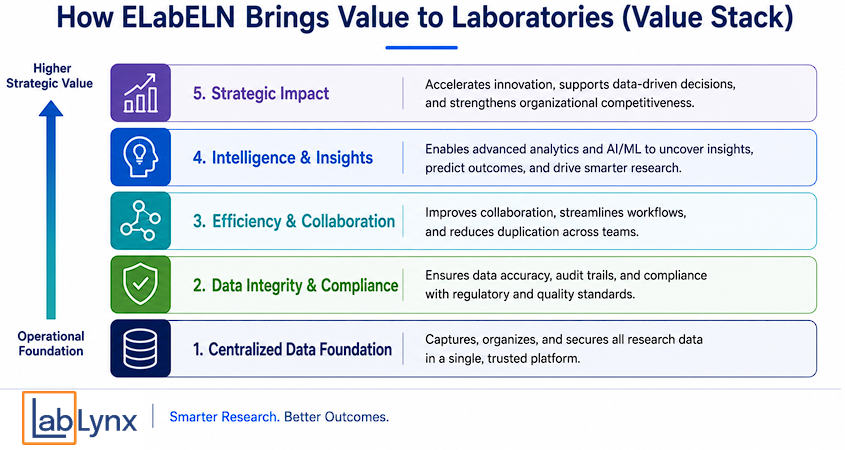
ELNs provide a foundation for transforming research workflows, enabling institutions to operate more efficiently, collaborate more effectively, and produce more reliable results. These benefits are not isolated—they reinforce each other, creating a compounding effect that enhances overall research performance.
For academic institutions facing increasing pressure to improve productivity, ensure compliance, and support innovation, ELNs offer a strategic solution. By centralizing and structuring research data, they enable researchers to focus on discovery rather than administrative tasks.
Improved Data Integrity and Organization
One of the most immediate and impactful benefits of ELNs is the improvement in data integrity and organization. Traditional methods of data recording often result in inconsistencies, incomplete records, and difficulty in locating information. ELNs address these issues by enforcing structure and standardization.
Through the use of templates and predefined fields, ELNs ensure that critical information is consistently captured. This reduces variability in how data is recorded and improves the overall quality of research documentation. Time-stamping and version control further enhance data integrity by providing a clear history of changes.
Improved organization also makes data more accessible. Researchers can quickly locate experiments, datasets, and supporting information using search and filtering tools. This reduces time spent on administrative tasks and allows researchers to focus on analysis and interpretation.
Enhanced Collaboration and Sharing
Collaboration is increasingly essential in academic research, particularly as projects become more interdisciplinary and global in scope. ELNs facilitate collaboration by providing a shared platform where researchers can access and contribute to data in real time.
ELNs also support controlled sharing, allowing researchers to define permissions and manage access to sensitive data. This ensures that collaboration does not compromise security or intellectual property. By enabling seamless and secure data sharing, ELNs enhance the efficiency and effectiveness of research teams.
Support for Open Science and Reproducibility
The principles of open science emphasize transparency, accessibility, and reproducibility. ELNs align closely with these principles by providing detailed, structured records of research activities.
Reproducibility is a critical aspect of scientific integrity. Without accurate and complete documentation, it is difficult to replicate experiments and validate results. ELNs address this challenge by capturing all relevant information, including methodologies, data, and analysis.
In addition, ELNs facilitate data sharing by organizing information in a way that is easy to understand and reuse. This supports open science initiatives and increases the impact of research by making it accessible to a broader audience.
Time and Cost Efficiency
ELNs significantly improve efficiency by reducing the time required for data entry, retrieval, and reporting. Automation and integration further streamline workflows, eliminating many manual processes.
For example, data generated by instruments can be automatically captured and linked to experiments, reducing the need for manual transcription. This not only saves time but also reduces the risk of errors.
Over time, these efficiencies translate into cost savings. Researchers can complete projects more quickly, and institutions can make better use of their resources. While the initial investment in an ELN may be significant, the long-term benefits often outweigh the costs.
Scalability and Institutional Impact
Another key benefit of ELNs is their ability to scale across different levels of an institution. While they can be implemented at the lab level, their true value is realized when they are deployed more broadly.
Institution-wide adoption enables standardization, improves data sharing, and supports centralized management of research activities. This creates a more cohesive research environment and enhances the institution’s ability to manage and leverage its data.
Scalability also ensures that the ELN can grow with the institution. As research programs expand and evolve, the system can adapt to meet new requirements. This flexibility is essential for supporting long-term research initiatives.
LabLynx Insight
 The LabLynx ELabELN Suite is designed to maximize these benefits by providing a unified, scalable platform. Its integration capabilities and flexible architecture enable institutions to connect multiple systems and workflows, creating a cohesive research environment.
By reducing complexity and improving data flow, LabLynx helps institutions achieve the full potential of ELN adoption. This positions it as not just a tool, but a strategic component of the research infrastructure.